This gallery contains 17 photos.

This gallery contains 17 photos.
I was disconnected from the rest of the world as my mobile phone was out of reach of any network. At the time I did not know that Softbank and au did not work in Kumano, only docomo was ok.
Undisturbed by phone calls and email requests and not distracted by the visual overload of adverts, I had nothing to listen to than nature’s sounds and nothing to look at than the expanse of forest and mountains in front of me. If it wasn’t for my inner voice…
It told me about all the things I had left unfinished in Tokyo before going on this trip and about all the actions-to-be-taken that were piling up during my absence from the connected world.
My inner voice turned out to be a chatterbox. It told me this and that about life in Tokyo, all of which was without relevance while walking here in the woods. Being so busy in my head sorting out priorities of things to do after my return, I did not even listen and see what was around me.
I had been walking like that for the first day and part of the second day when suddenly something caught my attention. It made me stop to have a closer look. It was a bright orange little crab that scurried across the trail in front of me! I did not know that crabs also lived in the mountains and later I learned that this was a freshwater crab.

This little crab stopped my mind’s chatter for a moment. I thought of it as a little friend of mine: I am born a Cancerian, and here there was this little crab hurrying across the trail as I, absent-minded, almost stepped on it.
It dawned on me that my walk in the woods somehow resembled how I was walking through life. Often I am so busy with myself that I don’t hear and see what is plain in front of me. Being in my own little world, the real world passes me by. Only when I stop, and look and listen, do I really see and hear.
Struggling up a steep hill to get to the next mountain pass, I get tired and sit down to rest at a lookout point. The serene beauty of the Kumano landscape eventually even stops the chatterbox inside.
Thinking nothing anymore, just taking all in with my five senses:
I see the multiple-shaded leaves of the fresh spring green, the shadows cast by cotton-wool clouds on the mountain slopes and the curled-up young leaves ferns growing toward the beams of sunlight shining through the forest canopy.
I hear the sharp cry of a kite in graceful flight high up in the sky, the deep humming of bumble-bees busily collecting their first nectar of the season, and the dreamlike barking of a dog in a distant village.
I smell the sweets scents from the colorful blossoms of nearby bushes and the earthy-wet scent from a bubbling creak in the valley.
I touch the bark of some trees, tempted to hug a tree (I did not know then that hugging a tree would become popular!).
Sitting there for a long while, I was not thinking anymore; not seeking the meaning of life anymore. I just enjoyed being there in that very moment. I felt blessed indeed on what I thought was a rare occasion of sheer bliss.
There was a voice very far away and almost not audible that said: Alena, why don’t you come again to Kumano? This is when I decided to walk the Kohechi trail of the Kumano Kodo in the following year during Golden Week.
During Golden Week 2009 I first walked the Nakahechi trail of the Kumano Kodo. It leads to the Hongu Taisha, one of the Three Kumano Grand Shrines, a sacred site for the Japanese. Then I continued on and walked to Nachi, where the second of the Grand Shrines is located. My final day I spent in Shingu, location of the third Grand Shrine.
I had only four days for this adventure, which turned out four very long days.
First I walked from Takijiri-oji to Chikatsuyu-oji in one day, and then from Chikatsuyu-oji to Hongu the next day. Hongu to Nachi I did on my third day, and the Koya-zaka and a visit to Shingu on my last day. This pattern is NOT! recommended. The walks each day turned out very long.
It did not help that I carried a heavy laptop in my backpack. What did I think to bring it along? Nowadays we have our smartphones at hand and in most places along the trail we can connect to the internet. No such thing in 2009! I guess I carried my laptop so that I could check the internet at the inn in the evening and see whether I had missed anything in Tokyo. Foolish!
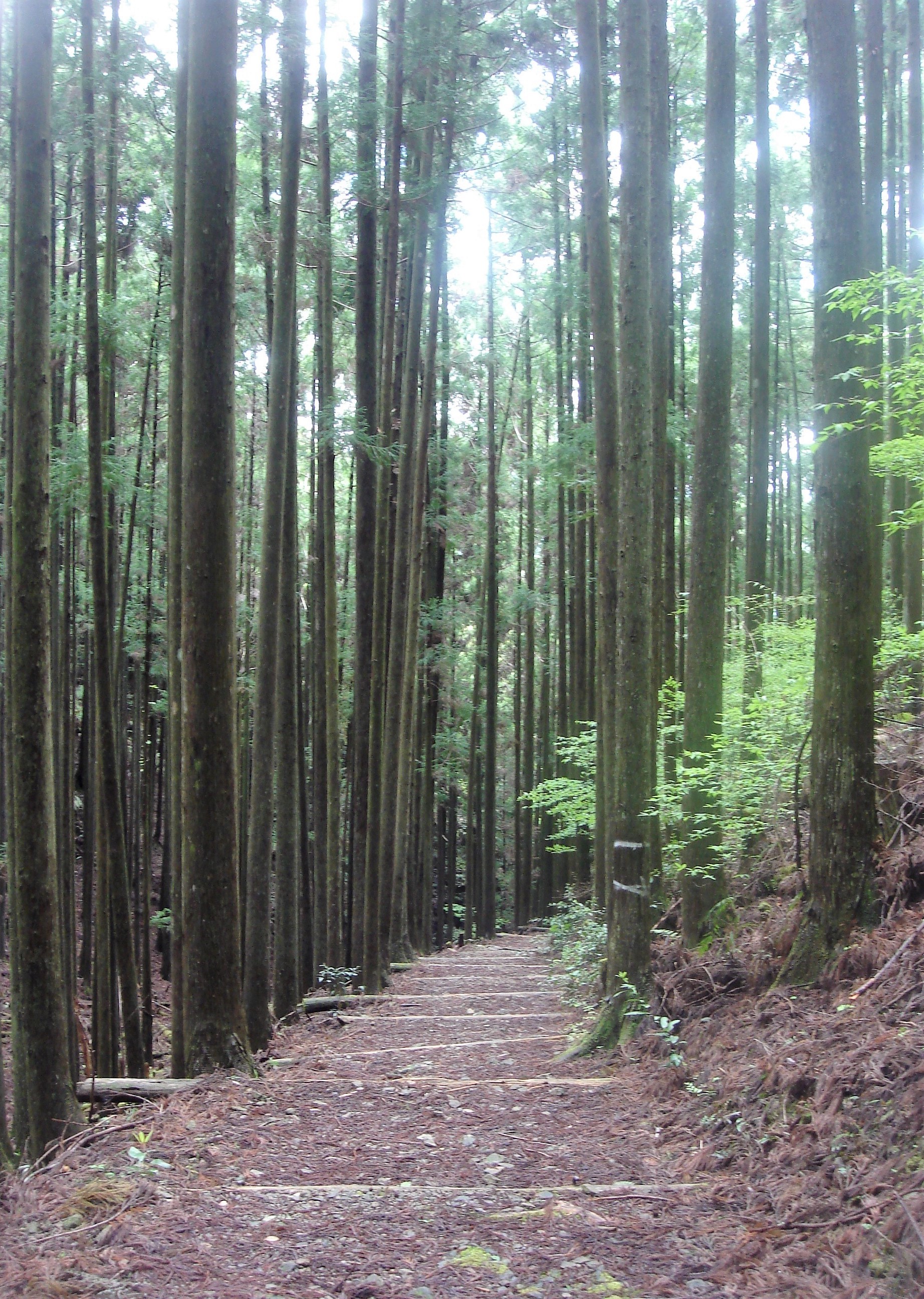
Each day I ascended some peaks and then walked down the slopes into a valley where a village offered shelter overnight at a minshuku, a Japanese-style inn.
After a long day walking, dinner served at the inns tasted super delicious.
I went to bed before 9 pm as there was nothing else to do at all. No neon light disturbed the pitch-black darkness outside and the quaking of frogs in the nearby rice fields soon lulled me into a deep sleep.
Mornings started early with an opulent breakfast, after all, you need strength to tackle a peak each day. The friendly pension owners prepare you a bento (lunch box) and you better take it. There are no convenience stores, the type of Lawson, Seven Eleven or FamilyMart. There are hardly any vending machines either for a quick stop and mini shopping for a cold beverage along the trail.
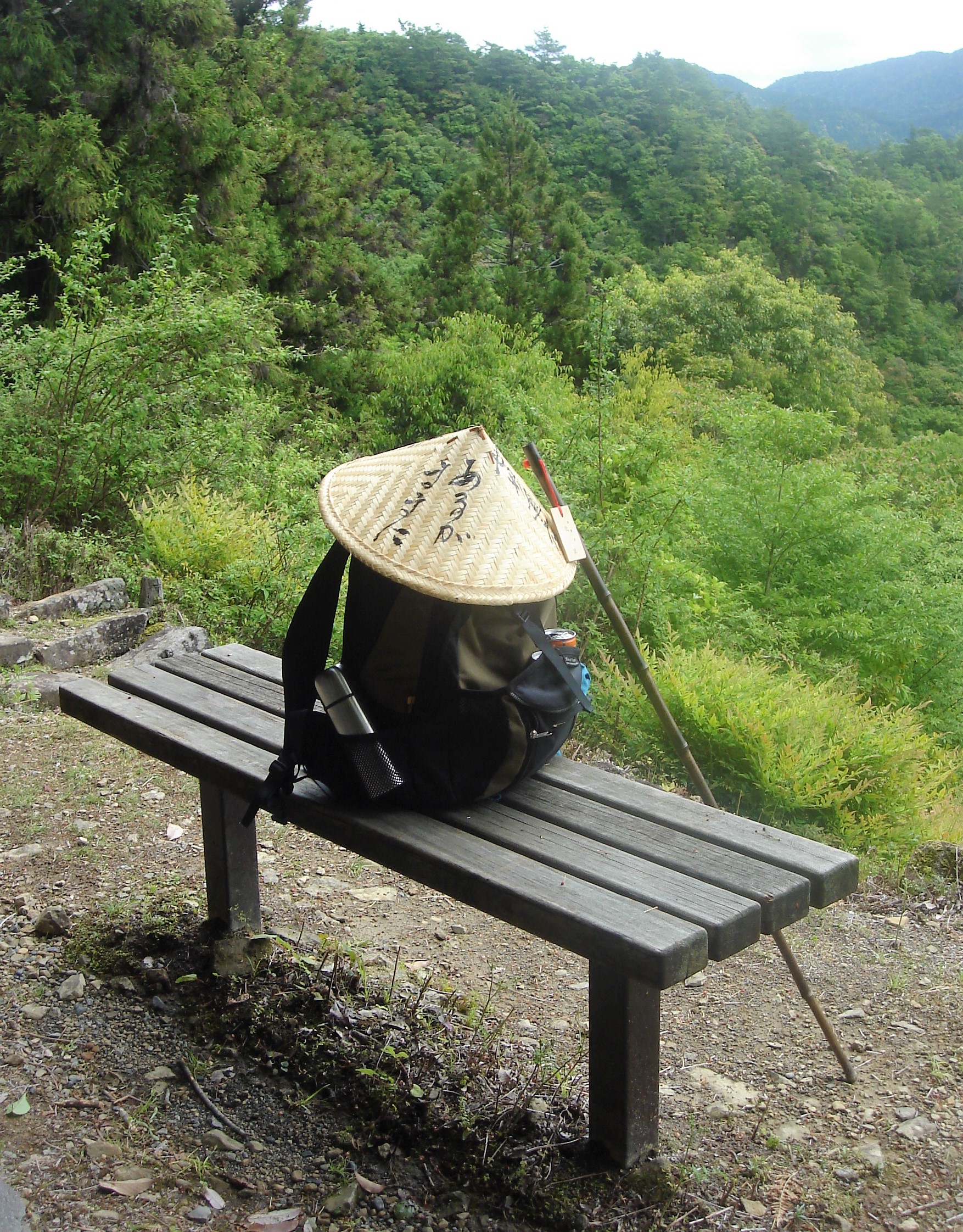
Both the hat and the staff that I got in Takijiri-oji turned out very handy. The hat sheltered me from the gushing rain on my first day of walk, and the staff helped me in my struggle up and down the hilly terrain, sensing out the trail ahead of me, and with fighting off spider webs.
Stepping over rocks and roots, the bamboo staff’s cling-clang alarmed the forest’s inhabitants of my coming so that I only saw the rear of some deer, a badger and a snake while birds and bees did not seem to be bothered by my presence at all. Crows and kits were fighting with each other, yet undisturbed by the whirring sound of a drone in the air.
The locals seem familiar with the seeker type of people. After all, they have seen and greeted pilgrims throughout the ages.
Tiny old women, so old that they seem ageless, offered big smiles and kind words. A farmer gave me a sip of cool spring water from his well. Another farmer’s woman handed over some oranges that seem present in all seasons in Kumano before she continued working in the fields.
So, there I was in a Tanabe guesthouse waking up to pouring rain. I hesitated for a moment to even get up. When I did, I had to run to Tanabe Station to catch the first bus out in direction of Hongu. The bus driver dropped me off at the roadside near Takijiri-oji, the ‘entrance’ of the Nakahechi trail. I walked across the bridge and sought shelter in a little shop, which amazingly was open even on such a rainy day.
The shopkeeper, an elderly Japanese man, asked me whether I had come to the area on a sightseeing trip. I tried to explain that what I was after was more looking inside than gazing at the scenery around me. He looked at me curiously and then got me a hat and a staff.
A conical straw hat and a wooden walking staff are part of the traditional outfit of pilgrims in Japan. I was reluctant at first to get decked in with what I thought was tourist drapery, but OK then, I thought: Maybe it is easier for the Kami-sama and Hotoke-sama, the Japanese Shinto and Buddhist deities, to keep a watchful eye on a foreign woman wandering around in the Japanese forest if I wear a recognizable hat.
A woman walking alone would be close to impossible in many countries of the world but Japan is a safe place still (touch wood!) where women may wander around in the mountains or forests by themselves. I told myself that I was equipped properly to deal with freak weather and I got a map to better navigate the trails which turned out very well sign-posted, even then.
I held the hat in my hands and hesitated a bit to put it on my head. I noticed that there were some words written on the hat あるがままに (“take things as they are”). This seemed a fair motto for a journey of introspection. Let’s be kind to myself and the world; no dissecting, analyzing and interpreting but just let things be.
The shopkeeper accompanied me to the small shrine nearby, the Takijiri-oji as it turned out. The rain still poured down. He showed me how to do a quick prayer Shinto-style, and then he pointed to the trail head behind the shrine before turning back to his shop.
There was nobody else in sight; the rain hammered in large drops on my straw hat; the flimsy rain gear was already in disarray and a very steep incline was ahead of me.
Kumano – The Land of the Gods, I am coming!
Pilgrimage – “a long journey or search of great moral significance”, according to Wikipedia, is usually associated with a religious or spiritual quests. This is not what I had in mind when I set out to walk the Kumano Kodo, what seemed some old pilgrimage trails in Japan’s Wakayama Prefecture.
This was back in 2009 when the Kumano Kodo was not famous yet and hardly any foreigners ventured down the Kii Peninsula beyond Wakayama City or Nara City. There was no entry on the Kumano Kodo in the Lonely Planet yet and no tour companies offering guided walks along the ancient trails. The Tanabe Tourism Bureau had just been set up.
I lived in Tokyo’s super-busy Shinjuku Ward at the time and I was between jobs, or let’s better call it between two phases of life: one had finished and the other not yet began. A time in-between. An intermediate state. A transitional phase. A threshold!
A liminal time, much like we find ourselves in now, in times of corona. A time when the old life does not feel right anymore but there is no blue-print yet for the future life. A time of searching; going on a pilgrimage does not seem far-fetched at all.
The three years preceding 2009, I had gone through a demanding executive training program, followed by an intensive martial arts program. Tokyo’s corporate way did not really satisfy me, neither did the martial way.
In Golden Week 2009 I simply wanted to have some space, physically and mentally, to think about life and all the small and big things going on. I wanted to get out of Tokyo and somewhere far away but I did not fancy a New Age-inspired holiday in anther Asian country. I just felt like “a walk without talk” in the woods, not a hike but more like a walking meditation.
The Kumano Kodo I had found by chance when I searched for the birthplace of the founder of Aikido, the martial arts that I trained in. I found Tanabe in the south of Wakayama Prefecture. When I looked for more information, I came across the Kumano Kodo trails.
The Kumano area, a mountain range full of scenic beauty, traditions and mystery, is often referred to as the spiritual heartland of Japan. For over 1,000 years Kumano has attracted Japanese worshipers and seekers and old trails, more or less intact, cross-cross the peninsula leading to some sacred sites. This was the perfect place for my “retreat” of sort.
I also found a point of contact at the Tanabe Tourism Bureau to whom I sent an email with questions about where to sleep and what bus to take. There was no Kumano Travel site yet to facilitate online booking of accommodations and services and there were no bus timetables online.
Thinking back, travelling to Kumano now seems so convenient and easy. The Tanabe Tourism Bureau has put in an incredible amount of work to facilitate the needs of foreign travelers to Kumano in the last ten years. Kudos to their visionary leaders and all their staff!
 Kii Retreats